
Modern software development relies heavily on automation, collaboration, and continuous delivery. DevOps practices help development teams build reliable, scalable applications while accelerating deployment cycles. One excellent example of applying these principles is the National Car Dealership Review Portal, a full-stack web application designed to allow users to explore dealerships across the United States and share customer experiences through reviews.
The project demonstrates how modern web technologies and DevOps workflows can be integrated into a complete solution. By combining technologies such as Django, React, Node.js, MongoDB, Docker, and cloud-based services, the platform provides a centralized portal where customers can discover dealerships, read reviews, and submit their own feedback.
This blog explores the project architecture, technology stack, DevOps workflow, and how to run the application locally.
Project Overview
The National Car Dealership Review Portal was built to solve a real business challenge: customers often want to know what others think about a dealership before making a purchase decision.
The platform enables:
- Users to view dealership listings across the country
- Customers to read reviews for each dealership
- Logged-in users to submit new reviews
- Administrators to manage dealership information
- Automatic sentiment analysis of reviews
The system is designed using a microservice-based architecture and integrates both backend and frontend technologies.
At its core, the application focuses on delivering a user-friendly interface with powerful backend services to manage data, authentication, and analytics. GitHub serves as the repository and collaboration platform for the project, allowing developers to manage code, track changes, and integrate DevOps workflows. Continuous integration and automation pipelines help ensure efficient software delivery and collaboration across development teams.
Key Features
1. Dealership Directory
Users can browse dealerships nationwide and filter them by state or location.
2. Customer Reviews
Customers can read reviews from other users to evaluate the quality of different dealerships.
3. Review Submission
Authenticated users can submit their own reviews describing their experience with a dealership.
4. Admin Management
Administrators can manage dealership data including car makes and models.
5. Sentiment Analysis
The system analyzes review text using a cloud-based sentiment analysis service to determine whether feedback is positive, negative, or neutral.
Technology Stack
The project uses a modern full-stack architecture that combines multiple frameworks and services.
Frontend
- React
- HTML5
- CSS
- JavaScript
React provides dynamic UI rendering and a responsive user experience.
Backend
- Django
- Node.js / Express
Django handles authentication, routing, and integration with the frontend, while Node.js manages dealership and review data.
Database
- MongoDB for reviews and dealership information
- SQLite for car model data
DevOps & Deployment
- Docker for containerization
- CI/CD pipeline for automated deployment
- Cloud-based sentiment analysis service
Containerization ensures that the application runs consistently across environments and simplifies deployment.
System Architecture
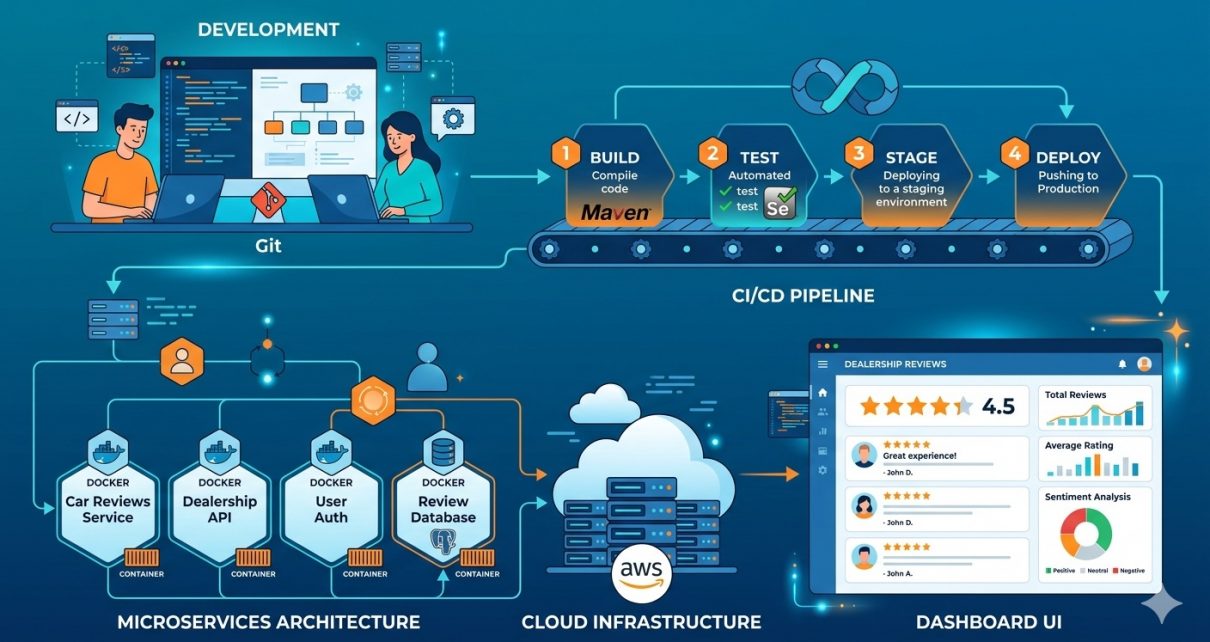
The project follows a microservice-based architecture consisting of several components:
- Frontend Application (React)
Provides the user interface and communicates with backend APIs. - Django Web Application
Handles authentication, routing, and integration with external services. - Node.js Microservice
Manages dealership and review data stored in MongoDB. - Sentiment Analyzer Service
Processes review text to determine sentiment. - Database Layer
Stores dealership details, reviews, and car model information.
This architecture ensures scalability and separation of concerns, making the system easier to maintain and extend.
DevOps Workflow Used in the Project
The project follows a DevOps-oriented workflow that integrates development, testing, and deployment processes.
1. Version Control
Developers push code to a shared repository hosted on GitHub, enabling collaboration and version tracking.
2. Continuous Integration
Every code update can trigger automated testing and builds through CI pipelines.
3. Containerization
Docker packages the application and its dependencies into containers.
4. Deployment
Containers can be deployed to cloud infrastructure where services run independently.
5. Monitoring and Iteration
Teams monitor application performance and iterate quickly based on feedback.
This DevOps workflow improves software reliability and accelerates development cycles.
Steps to Run the Project
Follow these steps to run the project locally.
Step 1: Clone the Repository
git clone https://github.com/sf-co/2-devops-national-car-dealership-review-portal
cd 2-devops-national-car-dealership-review-portal
Step 2: Setup Python Environment
Navigate to the backend directory and create a virtual environment.
cd server
python3 -m venv djangoenv
source djangoenv/bin/activate
Step 3: Install Dependencies
Install the required Python packages.
pip install -r requirements.txt
Step 4: Start Backend Services
Run the Django server.
python manage.py runserver
Step 5: Start the Node.js Service
Navigate to the Node service directory and install dependencies.
npm install
node server.js
Step 6: Run the Frontend
Navigate to the React frontend directory and start the application.
npm install
npm start
Step 7: Access the Application
Open the browser and navigate to:
http://localhost:3000
You should now see the dealership review portal running locally.
Why This Project Matters
Projects like this demonstrate how DevOps practices can support modern web applications. By integrating containerization, cloud services, and automated workflows, developers can build scalable systems with faster delivery cycles.
The dealership review portal is also a practical learning project for developers interested in:
- Full-stack development
- Microservice architecture
- DevOps automation
- Cloud deployment
- Sentiment analysis integration
It represents a real-world example of how multiple technologies can work together to deliver a production-ready application.
Conclusion
The National Car Dealership Review Portal is a powerful demonstration of how full-stack development and DevOps practices can work together to create scalable web platforms. With a modern technology stack, containerized deployment, and cloud-based analytics, the project showcases real-world engineering workflows used in modern software teams.
Whether you are a beginner exploring DevOps or an experienced developer looking to expand your full-stack skills, this project offers valuable insights into building and deploying a modern web application.