
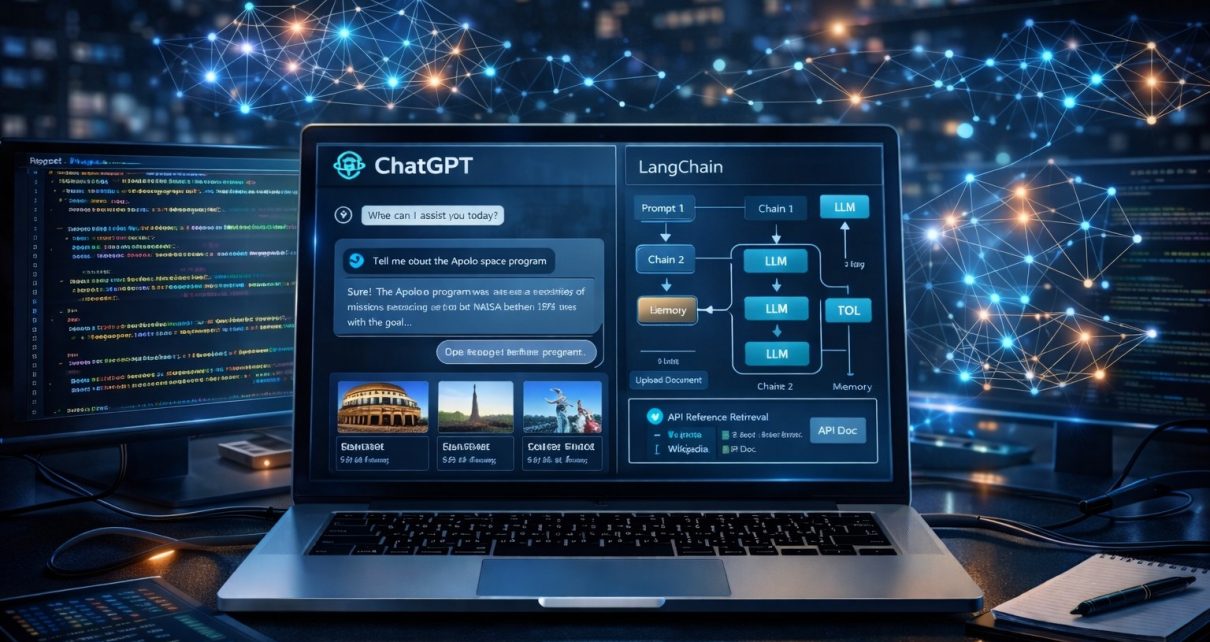
Generative AI has rapidly transformed how software applications are built. With powerful language models such as ChatGPT and frameworks like LangChain, developers can create intelligent applications capable of understanding natural language, retrieving information, and automating complex tasks.
If you want to learn how to build these applications, exploring real projects is one of the best approaches.
GitHub Repository:
https://github.com/sf-co/4-ai-chatgpt-and-langchain-apps
This repository provides four practical AI application examples built with ChatGPT and LangChain, allowing developers to understand how large language models (LLMs) can be integrated into modern software systems.
In this article, we’ll explore what the repository contains, why LangChain is important for AI development, and what skills developers can gain from building these projects.
The Rise of Generative AI Applications
Large language models have changed the way developers build software. Instead of relying only on predefined logic and rule-based systems, applications can now interpret and generate human language.
These models are used for a wide range of tasks including:
- Chatbots and virtual assistants
- Document summarization
- Code generation
- Customer support automation
- Knowledge search systems
To simplify development of these AI-powered systems, frameworks like LangChain help developers integrate language models into applications.
LangChain is a framework designed to build applications powered by large language models. It provides tools that help developers connect LLMs with data sources, APIs, and workflows.
This allows developers to create advanced AI systems such as chatbots, document analysis tools, and intelligent assistants.
Overview of the GitHub Repository
The repository 4-ai-chatgpt-and-langchain-apps demonstrates how developers can build practical generative AI applications using modern tools.
GitHub Repo:
https://github.com/sf-co/4-ai-chatgpt-and-langchain-apps
Instead of providing only theoretical examples, the repository focuses on real-world AI app implementations.
These projects illustrate how to:
- Integrate ChatGPT-style models into applications
- Build conversational interfaces
- Use LangChain to orchestrate AI workflows
- Connect LLMs with external data sources
- Create intelligent user experiences
By exploring these projects, developers can understand the architecture of modern AI-powered software.
What is LangChain and Why It Matters
When developers first experiment with language models, they often use APIs directly. While this works for simple tasks, building large AI applications requires more structure.
LangChain solves this challenge by providing a framework that organizes how language models interact with data, tools, and prompts.
Key capabilities of LangChain include:
Prompt Management
Developers can structure prompts more effectively and reuse them across applications.
Chaining AI Operations
Multiple AI tasks can be linked together in sequences called chains, allowing complex workflows to run automatically.
Memory Systems
LangChain can store conversation history, allowing chatbots to maintain context across interactions.
Tool Integration
Applications can connect LLMs with databases, APIs, and other services.
These features make LangChain a powerful tool for building scalable AI systems.
Types of AI Applications in the Repository
Although the repository focuses on four projects, they demonstrate several common patterns used in generative AI development.
1. AI Chatbot Applications
One of the most popular uses of language models is building chatbots.
AI chatbots can help users:
- Ask questions about products or services
- Get technical support
- Search knowledge bases
- Automate customer interactions
Unlike traditional rule-based chatbots, modern LLM chatbots understand natural language and generate contextual responses.
These applications simulate human conversation while leveraging the reasoning capabilities of large language models.
2. Document Question-Answering Systems
Another common AI application is a document-based question answering system.
These systems allow users to upload documents and ask questions about their contents.
For example, users might ask:
- “Summarize this report.”
- “What are the key findings?”
- “What does section three discuss?”
AI models analyze the document and provide contextual answers.
These systems are often built using Retrieval-Augmented Generation (RAG) pipelines that combine vector search with language models.
3. AI Content Generation Tools
Generative AI can also help create written content automatically.
Examples include:
- Blog article generators
- Marketing copy creators
- Email drafting assistants
- Social media content tools
These tools allow developers to build productivity applications that help users generate high-quality text quickly.
Because LLMs understand context and tone, they can adapt responses to different writing styles and purposes.
4. AI Workflow Automation
Modern AI systems are increasingly used to automate tasks.
AI-powered workflows can perform tasks such as:
- Research summarization
- Data extraction
- Task planning
- Information retrieval
LangChain enables these workflows by connecting language models with external tools and APIs.
This allows applications to behave more like AI agents that complete tasks automatically.
Skills Developers Can Learn from This Repository
Working through the projects in this repository can help developers develop several important skills.
Building AI-Powered Interfaces
Developers learn how to create applications that communicate with language models.
Prompt Engineering
Understanding how to design effective prompts is essential for getting high-quality responses from AI models.
AI Workflow Design
Developers learn how to structure chains and workflows that combine multiple AI tasks.
Integrating APIs and Data Sources
Many AI applications require connecting language models to databases or external APIs.
These skills are becoming increasingly important in modern software development.
Why AI Portfolio Projects Matter
As AI adoption grows, many companies are looking for developers who understand how to integrate AI capabilities into applications.
Building portfolio projects with ChatGPT and LangChain demonstrates:
- Practical AI development skills
- Understanding of LLM workflows
- Ability to build intelligent user interfaces
- Knowledge of modern AI frameworks
Repositories like this help developers move from experimentation to real AI applications.
Who Should Explore This Repository?
This repository is ideal for several types of developers.
AI Beginners
Developers new to generative AI can learn the fundamentals of building AI apps.
Machine Learning Enthusiasts
The projects provide practical examples of LLM-based systems.
Software Developers
Frontend or backend developers can learn how to integrate AI features into their applications.
Portfolio Builders
AI-powered apps are highly attractive projects for developer portfolios.
Final Thoughts
Generative AI is quickly becoming one of the most important technologies in modern software development. Developers who understand how to build applications using ChatGPT and frameworks like LangChain will have a significant advantage in the evolving tech landscape.
The 4-ai-chatgpt-and-langchain-apps repository provides a hands-on introduction to building real-world AI applications.
GitHub Repository:
https://github.com/sf-co/4-ai-chatgpt-and-langchain-apps
By exploring and experimenting with these projects, developers can gain valuable experience building AI-powered tools and better understand how language models can be integrated into modern applications.