
Artificial Intelligence is evolving beyond simple chatbots. Modern AI applications are increasingly built using multi-agent systems, where multiple AI agents collaborate to solve complex tasks. Instead of relying on a single large language model, developers can design specialized agents that communicate, reason, and coordinate together.
One fascinating example of this concept is the GitHub repository 13-ai-stateful-multi-agent-standup-comedy-chat-system, which demonstrates how to build a stateful multi-agent AI system capable of generating stand-up comedy conversations.
In this article, we will explore how the system works, the technologies used, and how you can run the project yourself.
What Is a Multi-Agent AI System?
A multi-agent system consists of multiple AI agents working collaboratively, each responsible for a specific role or task. Instead of one model trying to handle everything, tasks are distributed across agents to improve reasoning, creativity, and modularity.
Research and open-source frameworks show that assigning roles to multiple agents can produce better results because agents can verify, refine, and expand ideas collaboratively.
This architecture is especially useful in creative workflows like:
- Content generation
- Software development
- Research analysis
- Interactive storytelling
- Comedy generation
The stand-up comedy system leverages this idea by assigning different AI agents roles in creating and refining jokes.
Project Overview
The repository 13-ai-stateful-multi-agent-standup-comedy-chat-system demonstrates how to build a stateful AI chat environment where multiple agents collaborate to produce humorous stand-up comedy content.
Key capabilities of the system include:
- Multi-agent communication
- Stateful memory across conversations
- Role-based AI collaboration
- Interactive AI comedy dialogue
Instead of one AI generating jokes, the system creates an AI comedy team, where agents brainstorm, refine, and deliver humor together.
Key Features of the Project
1. Stateful Conversations
The system maintains conversation state, meaning agents remember previous messages and context.
Stateful AI agents store information from previous interactions, allowing them to maintain continuity and context over time.
Benefits include:
- Better storytelling
- Improved joke callbacks
- Context-aware responses
- More natural dialogue
2. Multi-Agent Collaboration
Each AI agent has a specific role, such as:
- Joke generator
- Humor evaluator
- Dialogue moderator
- Audience simulator
This structure mirrors real comedy writing teams, where multiple people collaborate to craft and refine jokes.
3. Role-Based Prompt Engineering
Each agent has its own system prompt that defines its personality and behavior.
For example:
Agent roles might include:
- Comedian Agent – writes jokes
- Critic Agent – improves humor quality
- Audience Agent – reacts to jokes
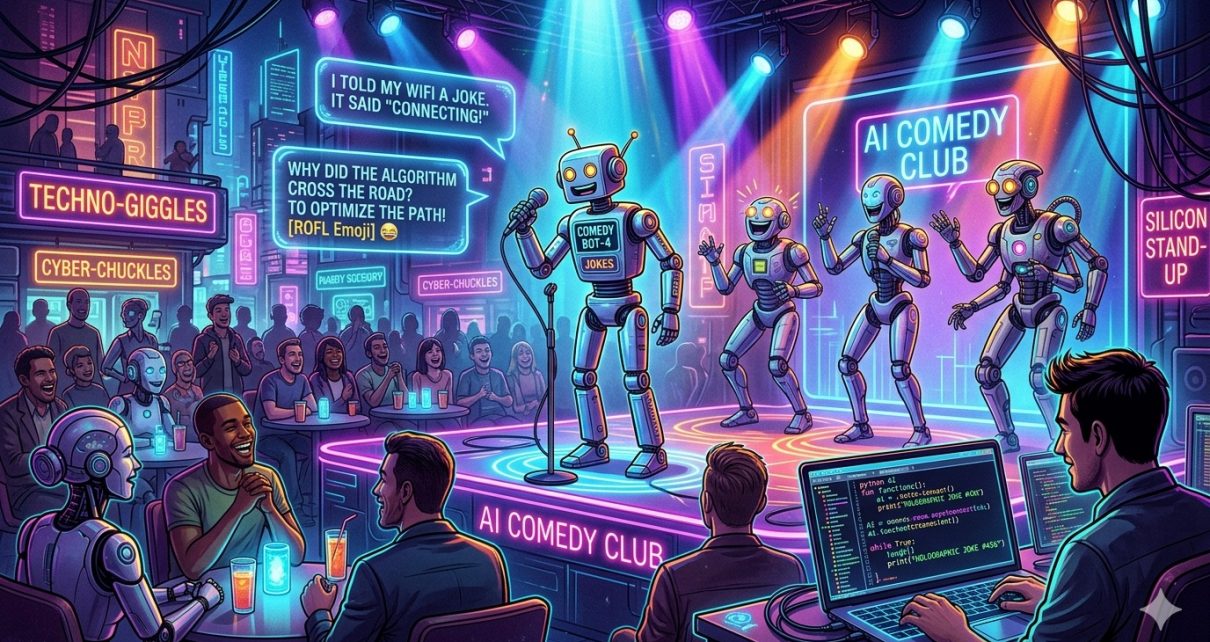
This creates a dynamic interaction where agents simulate a comedy club environment.
Technology Stack Used in the Project
The project demonstrates a typical AI agent workflow architecture built with modern AI development tools.
Core Technologies
1. Python
The primary programming language used to orchestrate agent communication and workflow.
2. Large Language Models (LLMs)
The system uses LLM APIs to generate dialogue and reasoning.
These models provide:
- Natural language generation
- reasoning capabilities
- humor generation
3. Multi-Agent Architecture
Multiple agents are created and orchestrated to collaborate on a shared task.
This architecture enables:
- distributed reasoning
- modular AI design
- better output quality
4. Stateful Memory
Conversation history is stored and reused so agents can reference earlier jokes or topics.
This improves narrative continuity.
5. Prompt Engineering
Each agent is guided with specialized prompts that define behavior, personality, and responsibilities.
Workflow of the AI Comedy System
The project follows a multi-agent conversational workflow.
Step 1 – User Input
The user provides a topic or prompt.
Example:
Write stand-up comedy about working from home.
Step 2 – Comedian Agent Generates Jokes
The primary agent produces the initial comedy material.
Example output:
Working from home is great...
Until your boss schedules a meeting called “quick sync”.
Those meetings last longer than my college degree.
Step 3 – Critic Agent Improves Humor
Another agent evaluates the joke and suggests improvements.
Example:
Add stronger punchline or exaggeration.
Step 4 – Audience Agent Reacts
The audience agent simulates reactions like:
- laughter
- feedback
- improvement suggestions
Step 5 – Conversation Continues
The system loops through agents until a final comedy routine is produced.
This creates a collaborative creative process.
How to Run the Project
Follow these steps to use the repository.
Step 1 – Clone the Repository
git clone https://github.com/sf-co/13-ai-stateful-multi-agent-standup-comedy-chat-system
Step 2 – Navigate to the Project
cd 13-ai-stateful-multi-agent-standup-comedy-chat-system
Step 3 – Install Dependencies
pip install -r requirements.txt
Step 4 – Configure API Keys
Set your LLM provider API key.
Example:
OPENAI_API_KEY=your_api_key
Step 5 – Run the Application
python main.py
Step 6 – Start Interacting
Enter prompts and watch multiple agents collaborate to create comedy content.
Example prompt:
Create a stand-up comedy routine about AI replacing jobs.
Why Multi-Agent Systems Matter
Multi-agent architectures are becoming increasingly important because they enable distributed intelligence.
Instead of one model trying to solve everything, specialized agents:
- divide complex problems
- collaborate on reasoning
- verify each other’s outputs
- produce higher-quality results
This design approach is already being used in advanced AI research and real-world applications.
Potential Extensions for the Project
Developers can expand the project with:
- voice-based comedy performance
- real-time audience feedback
- reinforcement learning for humor optimization
- multi-model agent collaboration
- streaming comedy generation
You could even turn it into an AI comedy club simulation.
Final Thoughts
The 13-ai-stateful-multi-agent-standup-comedy-chat-system project is a creative demonstration of how multi-agent AI systems can collaborate to produce complex outputs like stand-up comedy.
By combining:
- stateful memory
- role-based agents
- prompt engineering
- LLM orchestration
developers can build AI systems that behave more like teams rather than individual chatbots.
As AI agent ecosystems continue to grow, projects like this provide valuable insight into the future of collaborative AI architectures.