
As artificial intelligence continues to evolve, one of the most powerful advancements in recent years has been the rise of Retrieval-Augmented Generation (RAG). This approach enhances traditional AI models by combining them with external knowledge sources, enabling more accurate, context-aware, and up-to-date responses.
The AI RAG Knowledgebase Chat with Vector Visualization project is a compelling example of how RAG can be implemented in a practical, developer-friendly way. It goes beyond a simple chatbot by integrating a knowledge base, semantic search, and—most interestingly—vector visualization. This allows developers and users not only to interact with data but also to see how information is structured and retrieved.
In this blog post, we’ll explore what makes this project unique, how it works, and why it’s an important step toward more transparent and intelligent AI systems.
🧩 What Is This Project About?
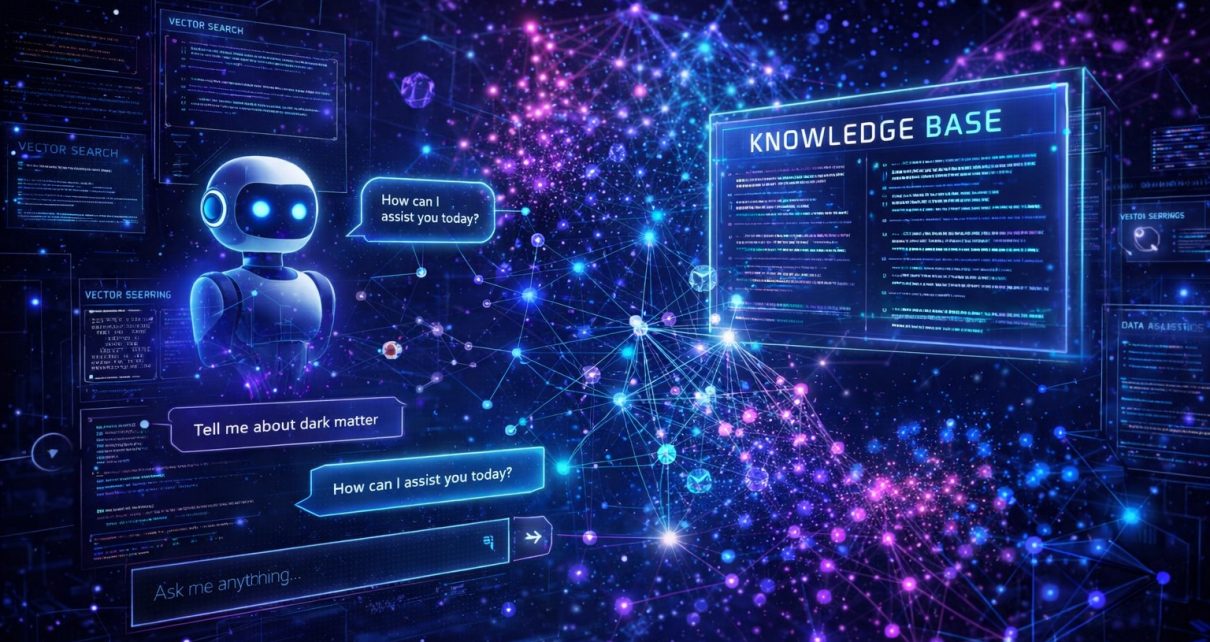
At its core, this project is an AI-powered chatbot that uses a RAG architecture to answer questions based on a custom knowledge base. Instead of relying solely on a pre-trained model, it retrieves relevant information from stored documents and uses that context to generate better responses.
What sets this project apart is its vector visualization capability. When documents are processed, they are converted into embeddings—numerical representations that capture semantic meaning. These embeddings are then visualized, helping users understand how different pieces of information relate to each other in a multi-dimensional space.
This combination of chat + retrieval + visualization creates a powerful tool for both learning and development.
⚙️ How It Works
The system follows a structured pipeline:
1. 📄 Data Ingestion
Documents are loaded into the system and preprocessed. This can include PDFs, text files, or other structured data sources.
2. 🔢 Embedding Generation
Each piece of content is transformed into a vector using embedding models. These vectors represent semantic meaning, allowing the system to understand context rather than just keywords.
3. 🗂️ Vector Storage
The embeddings are stored in a vector database, enabling fast similarity search. When a user asks a question, the system retrieves the most relevant vectors based on semantic similarity.
4. 💬 Chat with Context
The retrieved data is passed into a language model, which generates a response grounded in the knowledge base.
5. 📊 Vector Visualization
Here’s where the project shines: it visualizes embeddings in a 2D or 3D space, helping users see relationships between documents, clusters, and topics.
🌟 Key Features
🤖 Retrieval-Augmented Chat
The chatbot provides more accurate answers by grounding responses in real data rather than relying purely on model memory.
📊 Interactive Vector Visualization
Users can explore how data points relate to each other. Clusters of similar content become visually apparent, making it easier to understand large datasets.
⚡ Semantic Search
Instead of keyword matching, the system uses meaning-based retrieval, significantly improving search quality.
🧠 Knowledge Base Integration
You can plug in your own data, making this tool adaptable for documentation, research, or internal company knowledge systems.
🛠️ Developer-Friendly Design
The project is structured in a way that makes it easy to extend, modify, and integrate into other applications.
🛠️ Technologies Used
This project leverages a modern AI stack:
- Python – Core programming language
- Vector Databases – For storing and retrieving embeddings
- Embedding Models – To convert text into semantic vectors
- Large Language Models (LLMs) – For generating responses
- Visualization Libraries – For plotting vectors in 2D/3D space
- Web Frameworks / UI Tools – For building the chat interface
Together, these technologies create a seamless pipeline from raw data to intelligent interaction.
💡 Why This Project Matters
1. Transparency in AI
One of the biggest challenges in AI is the “black box” problem. By visualizing embeddings, this project provides insight into how the system understands data.
2. Better Knowledge Management
Organizations can use this system to build intelligent knowledge bases that are easy to query and explore.
3. Improved Search Experience
Semantic search ensures users get relevant results even if they don’t use exact keywords.
4. Educational Value
For developers learning about RAG systems, this project serves as an excellent hands-on example.
🔍 Real-World Use Cases
This project can be applied in various domains:
- Customer Support Systems – Provide accurate answers from documentation
- Internal Knowledge Bases – Help teams quickly find relevant information
- Research Tools – Explore and visualize large datasets
- Educational Platforms – Teach concepts using interactive AI systems
In each of these scenarios, the ability to combine retrieval with visualization adds significant value.
📈 The Power of Vector Visualization
Vector visualization is often overlooked in AI applications, but it plays a crucial role in understanding how models interpret data.
By plotting embeddings, users can:
- Identify clusters of similar documents
- Detect outliers or anomalies
- Understand topic distribution
- Improve data organization
This makes the project not just a tool for interaction, but also a tool for insight.
🧩 Challenges & Considerations
While powerful, the project comes with some challenges:
- Scalability – Large datasets may require optimized storage and indexing
- Dimensionality Reduction – Visualizing high-dimensional vectors requires techniques like PCA or t-SNE
- Data Quality – The accuracy of responses depends heavily on the quality of the knowledge base
Addressing these challenges is key to building robust RAG systems.
🔮 Future Potential
This project opens the door to several exciting possibilities:
- Real-time data updates in the knowledge base
- More advanced visualization techniques
- Integration with enterprise tools
- Multi-modal support (images, audio, etc.)
- Enhanced user interfaces for exploration
As AI continues to evolve, tools like this will become essential for making systems more interpretable and effective.
🏁 Conclusion
The AI RAG Knowledgebase Chat with Vector Visualization project is a powerful demonstration of how modern AI techniques can be combined to create intelligent, transparent, and interactive systems.
By integrating retrieval-augmented generation with vector visualization, it not only improves the accuracy of AI responses but also provides valuable insights into how data is structured and understood.
Whether you’re a developer, researcher, or AI enthusiast, this project is a must-explore example of the future of intelligent systems.
👉 Check it out on GitHub:
https://github.com/sf-co/23-ai-rag-knowledgebase-chat-vector-visualization