
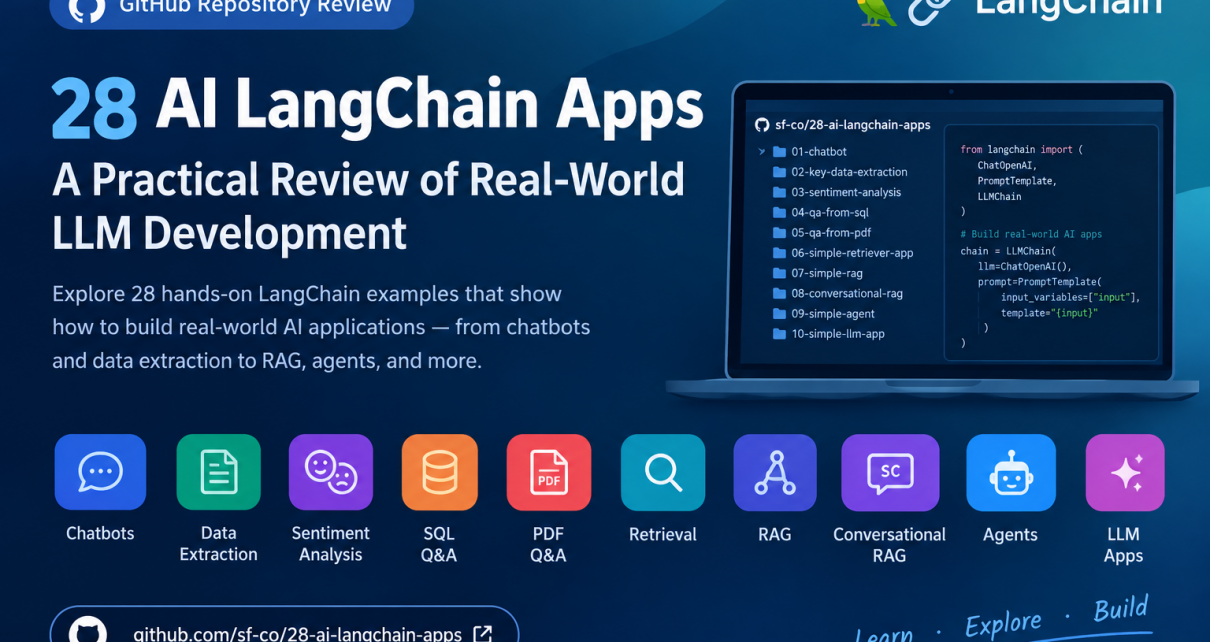
The AI LangChain Apps repository is a practical collection designed to demonstrate how LangChain can be used to build real-world generative AI applications. Rather than focusing only on theory, the project presents a progression of hands-on examples covering conversational AI, data extraction, sentiment analysis, SQL question answering, PDF-based Q&A, retrieval, RAG, conversational RAG, agents, and LLM applications.
One of the repository’s biggest strengths is its learning-oriented structure. The examples are organized into separate folders, including 01-chatbot, 02-key-data-extraction, 03-sentiment-analysis, 04-qa-from-sql, 05-qa-from-pdf, 06-simple-retriever-app, 07-simple-rag, 08-conversational-rag, 09-simple-agent, and 10-simple-llm-app. This makes it easier for developers to study individual concepts without navigating a large, complicated application.
The selection of examples also reflects an important reality of modern AI development: useful LLM applications involve much more than simply sending a prompt to a model. Retrieval, structured data, documents, conversational context, embeddings, agents, and external services all play important roles. LangChain provides the orchestration layer that connects these components into usable workflows.
For beginners, the repository can serve as a useful starting point for understanding how individual AI capabilities evolve into more sophisticated applications. The progression from a basic chatbot toward retrieval-augmented generation and agents provides a natural way to explore increasingly complex architectures.
For experienced developers, the repository is more useful as a reference and experimentation playground. The relatively focused examples make it possible to inspect an approach, adapt it, and use it as a foundation for a larger project.
There are also limitations. The repository currently appears to be a small project with only two commits and no stars, forks, issues, or published releases on GitHub. Its README provides a high-level description but relatively little documentation about setup, dependencies, configuration, testing, or deployment. Therefore, developers looking for production-ready infrastructure will likely need to add their own testing, security, observability, error handling, and deployment practices.
Overall, AI LangChain Apps is best viewed as a hands-on collection of examples rather than a finished production framework. Its greatest value is the breadth of practical concepts it introduces and the clear separation of individual application patterns. For anyone learning LangChain or experimenting with RAG, agents, document processing, and LLM-powered applications, it provides a useful set of ideas to study, modify, and build upon.
For more visit link: https://github.com/sf-co/28-ai-langchain-apps