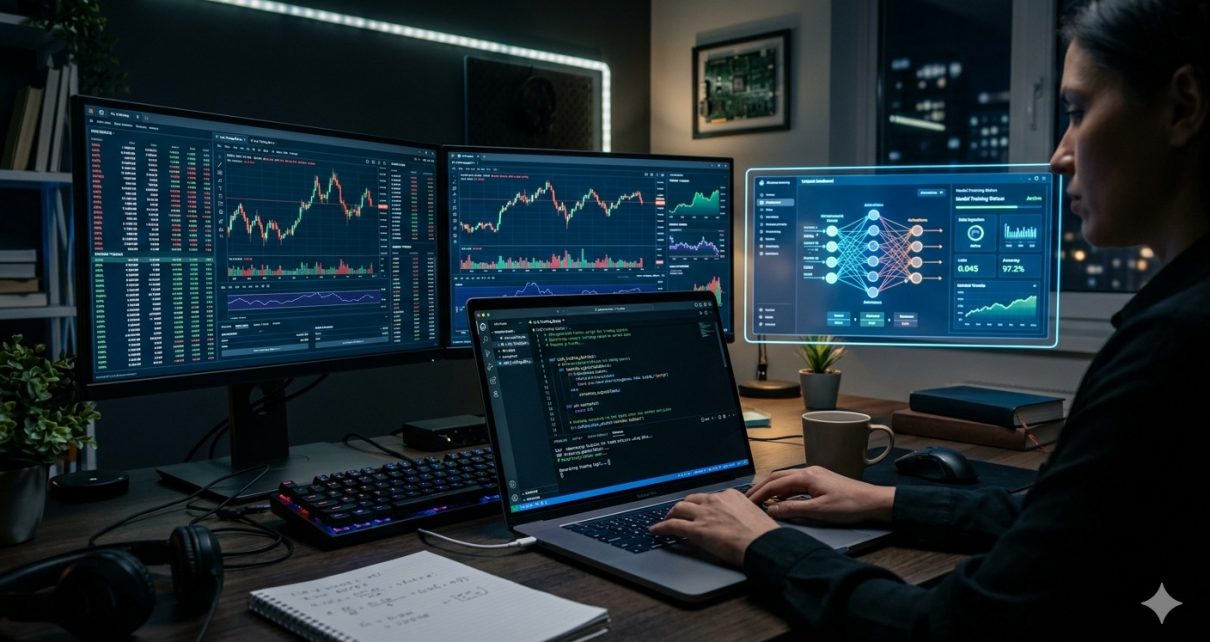
Large Language Models (LLMs) have significantly transformed how developers write code. From code completion tools to automated development assistants, AI can now generate functional code snippets based on natural language prompts. One exciting application is AI-generated trading algorithms, where models can produce trading functions for financial strategies.
The GitHub project “AI QLoRA Fine-Tuned Trading Code Generator” demonstrates how to fine-tune a coding model to automatically generate Python trading functions using modern machine learning techniques. The project focuses on training a specialized AI model capable of producing structured trading logic based on a dataset of trading examples.
In this blog, we’ll explore how the project works, the technologies used, and how you can run and experiment with it yourself.
What is the AI QLoRA Trading Code Generator?
The project fine-tunes a Code LLM (Large Language Model) to generate trading functions automatically.
It uses QLoRA (Quantized Low-Rank Adaptation), a technique that allows developers to fine-tune large language models efficiently while using significantly less GPU memory. QLoRA works by training small adapter layers on top of a quantized base model rather than updating the entire model.
In this project, the model is trained on a dataset of trading examples so it learns patterns related to trading strategies, indicators, and algorithmic logic. The resulting model can then generate Python functions such as:
- Trading strategies
- Entry/exit signals
- Risk management rules
- Indicator-based algorithms
According to the project overview, the workflow includes preparing a dataset of trade() function examples, formatting them for supervised fine-tuning, and training the model using modern machine learning libraries.
Key Features of the Project
1. AI Code Generation for Trading
The trained model generates Python functions for algorithmic trading.
2. Efficient Fine-Tuning with QLoRA
QLoRA enables training large models with limited GPU resources by using 4-bit quantization and adapter layers.
3. Custom Dataset Training
The model is trained on a dataset specifically designed for financial trading logic.
4. Lightweight Training Pipeline
The project can be trained using cloud environments such as Google Colab.
5. Experiment Tracking
Training runs can be monitored using experiment tracking tools.
Technologies Used in the Project
The project uses a modern AI development stack focused on machine learning and model fine-tuning.
Programming Language
- Python
Machine Learning Frameworks
- PyTorch
- Hugging Face Transformers
Fine-Tuning Tools
- PEFT (Parameter Efficient Fine Tuning)
- QLoRA
Training Utilities
- TRL (SFTTrainer)
- BitsAndBytes for 4-bit quantization
Monitoring & Experiment Tracking
- Weights & Biases
Model & Dataset Hosting
- Hugging Face Hub
These technologies together create an efficient pipeline for training and deploying AI models specialized in financial code generation.
Project Workflow Overview
The project follows a typical LLM fine-tuning pipeline:
- Dataset creation
- Data preprocessing
- Model loading
- QLoRA fine-tuning
- Evaluation and testing
- Deployment or sharing
This workflow helps developers build domain-specific AI models capable of generating accurate code for particular tasks.
How to Run the Project
Below is a simple guide to run the project locally.
Step 1: Clone the Repository
First, clone the GitHub repository:
git clone https://github.com/sf-co/8-ai-qlora-fine-tuned-trading-code-generator.git
Navigate into the project directory:
cd 8-ai-qlora-fine-tuned-trading-code-generator
Step 2: Create a Python Environment
Create a virtual environment to manage dependencies.
python -m venv venv
Activate the environment.
For Mac/Linux:
source venv/bin/activate
For Windows:
venv\Scripts\activate
Step 3: Install Dependencies
Install the required Python packages:
pip install -r requirements.txt
Typical dependencies include:
- torch
- transformers
- datasets
- peft
- bitsandbytes
- accelerate
These libraries handle model training, dataset processing, and GPU optimization.
Step 4: Prepare the Dataset
The dataset contains examples of Python trading functions.
Example format:
def trade(data):
    if data["rsi"] < 30:
        return "buy"
    elif data["rsi"] > 70:
        return "sell"
    else:
        return "hold"
The dataset is converted into a format suitable for supervised fine-tuning.
Step 5: Run the Fine-Tuning Script
Start training the model:
python train.py
During training, the script will:
- Load the base model
- Apply QLoRA adapters
- Train the model on the trading dataset
- Save the fine-tuned model
Training progress can be monitored through logging tools.
Step 6: Test the Model
After training, you can generate trading code using prompts.
Example prompt:
Generate a Python function for a moving average crossover strategy.
Example output:
def trade(data):
    if data["short_ma"] > data["long_ma"]:
        return "buy"
    else:
        return "sell"
This demonstrates how the AI model can assist developers in building algorithmic trading strategies.
Why QLoRA is Important
Traditional fine-tuning of large language models requires expensive hardware. QLoRA solves this challenge by reducing memory usage while maintaining performance.
Key advantages include:
- Train large models on smaller GPUs
- Lower computational cost
- Faster experimentation cycles
- More accessible AI development
QLoRA enables developers to fine-tune models with billions of parameters using consumer hardware.
Potential Use Cases
This project can be used in several real-world scenarios.
Algorithmic Trading Development
Developers can quickly prototype trading strategies.
Financial AI Research
Researchers can experiment with AI models for financial data.
Coding Assistants
Custom AI assistants for financial programming.
Educational Projects
Students learning about LLM fine-tuning and AI engineering.
Final Thoughts
The AI QLoRA Fine-Tuned Trading Code Generator is a great example of how modern machine learning techniques can be applied to specialized domains like finance. By combining LLMs with efficient fine-tuning methods such as QLoRA, developers can create powerful AI tools capable of generating domain-specific code.
Projects like this demonstrate the future of AI-assisted programming, where models are trained on specific datasets to become experts in particular tasks.
If you’re interested in AI engineering, financial technology, or LLM fine-tuning, this project is an excellent starting point for building your own specialized AI coding assistants.