
Meetings are the backbone of team collaboration, strategy alignment, and decision‑making across organizations. But anyone who has ever had to produce meeting minutes knows this: writing them is tedious, time‑consuming, and often done long after the ideas have faded from memory.
What if you could automate that entire process — turning raw meeting audio into structured, actionable minutes with minimal human effort?
That’s the core idea behind the open‑source repository 21‑AI‑Automated‑Meeting‑Minutes‑Generator (GitHub) — a project that applies AI and modern speech‑to‑text techniques to transform meeting recordings into readable, summarized, and insight‑rich minutes. Let’s explore what this tool is, how it works, and why it matters.
🌐 What Is the 21‑AI Automated Meeting Minutes Generator?
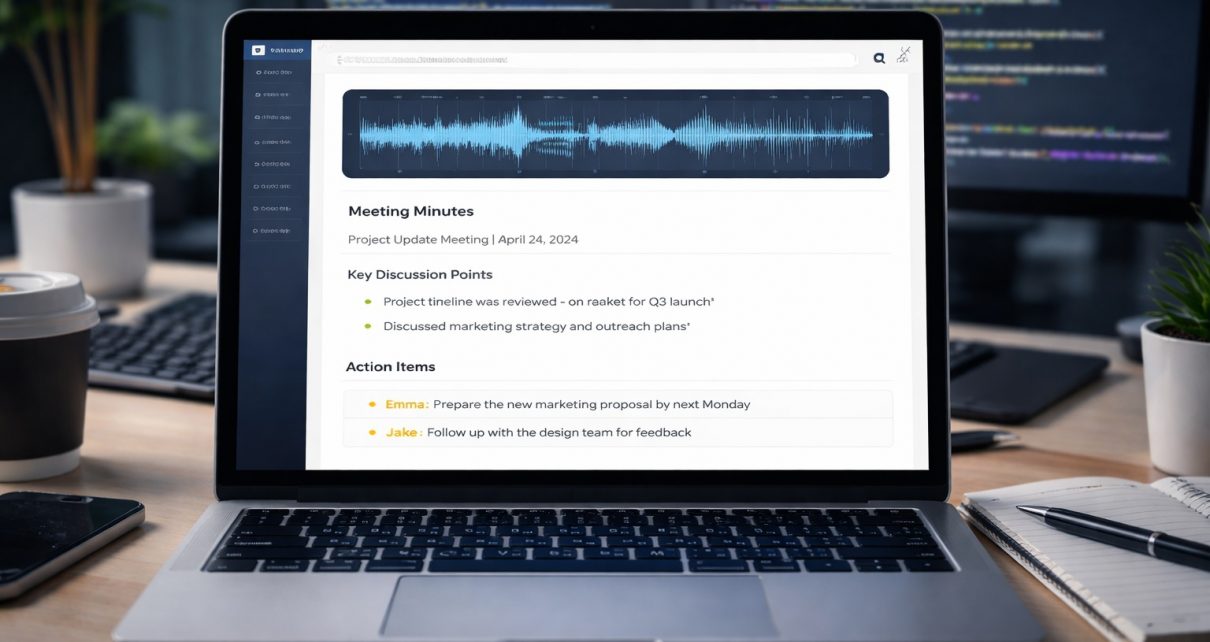
The 21‑AI Automated Meeting Minutes Generator is an open‑source approach to automating recounting meetings from audio. At a high level, the repository shows how to take an audio recording, transcribe it, and then use AI models to generate a structured summary of what was discussed — including key points and action items. Although the repo is early stage with limited stars and contributions, the vision is clear: reduce hours of post‑meeting work into a few minutes of automatic processing.
Unlike manual minutes writing (which relies on note‑takers), this tool embraces emerging AI transcription and summarization techniques to produce human‑readable minutes with reasonable fidelity.
🧠 Why Automated Minutes Matter
Before diving into technical specifics, let’s briefly cover why automating minutes is important.
Traditionally, meeting minutes are created by someone who must attend the entire meeting, capture discussions, decide what’s important, and then format this into a document. It’s slow, error‑prone, and detracts from the actual work.
AI‑powered tools that automate this — including industry products and open‑source projects — leverage speech‑to‑text models and advanced summarizers to:
🗣 Accurately transcribe dialogue
🧾 Extract key decisions and points
🤝 Highlight action items and owners
📄 Output professional summaries faster than humans
This automation saves time, improves accuracy, and lets teams focus on action instead of documentation.
🛠️ How It Works: Under the Hood
Though this project is not yet a fully polished application, the components shown in the repository illustrate a clear workflow.
Here’s a conceptual breakdown of the steps involved:
🎙 Step 1: Audio Input
The system starts with an audio recording of a meeting. This can be any file — for example, a denver_extract.mp3 in the repo — representing actual spoken discussion.
🧾 Step 2: Transcription
Using a speech recognition engine (like OpenAI’s Whisper or a pipeline built on HuggingFace models), the audio is converted into raw text. This is the foundation — everything the AI generates next comes from this transcript.
Modern speech‑to‑text models are impressively accurate, even with accents and diverse speakers. They turn hours of conversation into textual form in minutes.
🧠 Step 3: AI‑Driven Summarization
Once the meeting is transcribed, language models step in to analyze and summarize. Here’s where the power of LLM (Large Language Models) shines:
- Separate meaningful points from filler content
- Extract decisions made
- Identify action items and assign them to specific stakeholders
- Format content into readable meeting minutes
This step is crucial because a simple transcript — while useful — doesn’t replace well‑written minutes. The AI transforms raw text into something understandable, structured, and useful.
📊 Step 4: Output Formats
The repository demonstrates outputting the results in markdown — a human‑friendly format. But the concepts could easily extend to:
- Word documents
- PDF summaries
- Automated emails to stakeholders
The flexibility means teams can integrate AI minutes into existing workflows.
🤖 Applications and Real‑World Use Cases
While the 21‑AI Automated Meeting Minutes Generator itself is a technical project, the idea applies broadly across industries:
🧑💼 Corporate Teams
Imagine automatically generating minutes from weekly syncs, team standups, or client calls. Teams save hours of work while capturing critical decisions and next steps.
🏛 Government and Public Bodies
City councils and boards often publish detailed minutes for public transparency. Automated tools — especially open source — could help with consistent documentation.
🤝 Remote Collaboration
Distributed teams especially benefit when every meeting is documented clearly — even if participants are spread across time zones.
🧠 Knowledge Workers
Researchers, legal professionals, and consultants can better track conversations and decisions without juggling notebooks.
🛠 How You Can Contribute
One of the strengths of this being a GitHub project is that contributors can shape its direction. Here are some ways developers can help:
- Add real‑time transcription
- Improve speaker diarization (label speakers)
- Build a web UI for easy uploads
- Export to multiple formats (DOCX, PDF, HTML)
- Integrate with platforms (Google Meet, Zoom)
Even though open source tools — like Meminto and others — pursue similar goals, community involvement accelerates development and brings unique use cases into focus.
✨ Challenges and Considerations
Automated meeting minutes tools are exciting, but they come with challenges:
🗣 Speaker Diarization
Separating who said what isn’t trivial — especially in multi‑participant meetings. Better diarization leads to more useful minutes.
🧠 Context Awareness
AI models understand language, but nuanced context (industry jargon, cross‑talk) still challenges them. Prompt engineering can improve results.
🔐 Privacy and Security
Audio recordings often contain sensitive information. Open source tools that run locally — without cloud dependencies — are valuable for confidential meetings.
Despite these challenges, projects like this push the boundary on what’s possible with accessible AI.
🔚 Final Thoughts
The 21‑AI Automated Meeting Minutes Generator represents a promising step in turning monotonous documentation into an automated, AI‑driven workflow. It’s a practical example of how speech recognition and large language models can solve real pain points.
If you’ve ever sat down after a long meeting and dreaded writing the minutes, this direction of AI development should excite you — and maybe even make you want to contribute!
Check out the repo, explore the code, and imagine what automated meetings could look like in your own organization.