
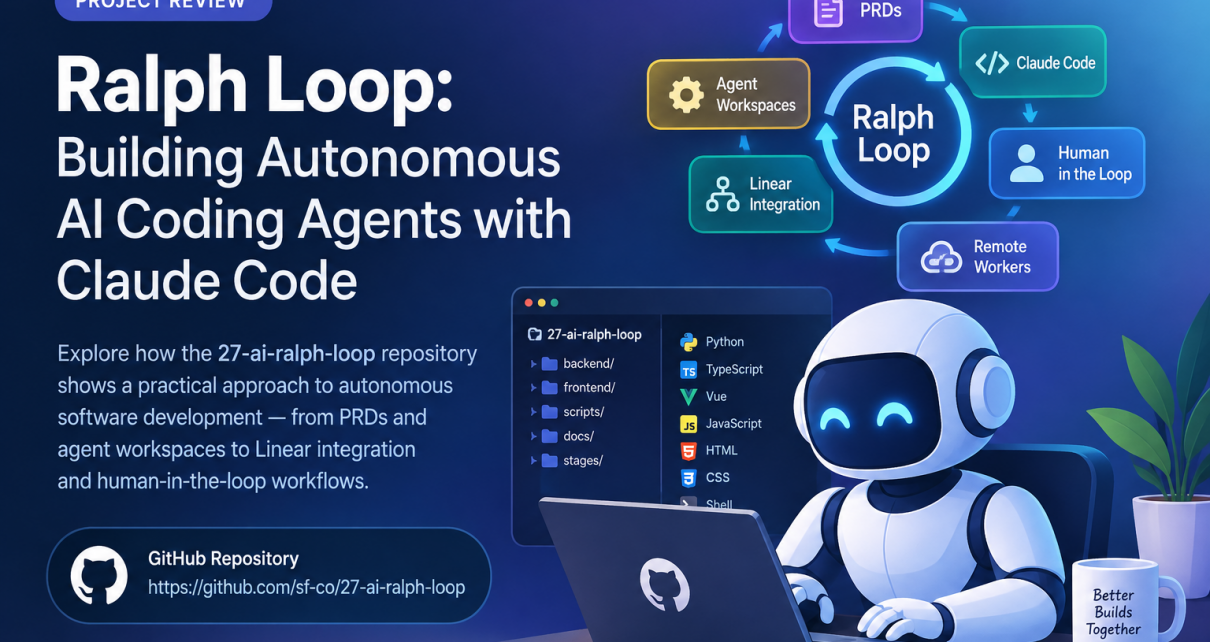
AI coding agents are moving beyond simple code completion toward autonomous software development. The 27-ai-ralph-loop repository is an interesting hands-on exploration of that idea, built around Claude Code and the “Ralph Loop” approach.
The project demonstrates how an AI coding agent can be orchestrated to work through complex development tasks while maintaining structure and control. Rather than simply asking an AI to “build an application,” the repository explores concepts such as Product Requirements Documents (PRDs), agent workspaces, permissions, hooks, human-in-the-loop workflows, remote workers, and Linear issue tracking.
One of the most useful aspects is its progressive organization. The repository contains separate stages covering the basic loop, PRD-driven development, permission hooks, CLI tooling, agent workspaces, Linear integration, human oversight, remote workers, and workflow improvements. This makes it useful not only as a project, but also as a learning resource for understanding how autonomous coding systems can be designed.
Technically, the project combines Python for backend orchestration with TypeScript, Vue, JavaScript, HTML, and CSS on the frontend, alongside shell scripts for configuration and tooling.
The repository is still early-stage—it currently has a single commit and no published releases—but its structure provides a useful look at the building blocks behind autonomous AI development workflows.
Explore the project:
https://github.com/sf-co/27-ai-ralph-loop